
 info@edpo.com
What Is A RoPA? Record Of Processing Activities Under Article 30 GDPR (Including Non-EU Companies)
Article 30 GDPR explained for EU and non-EU organisations


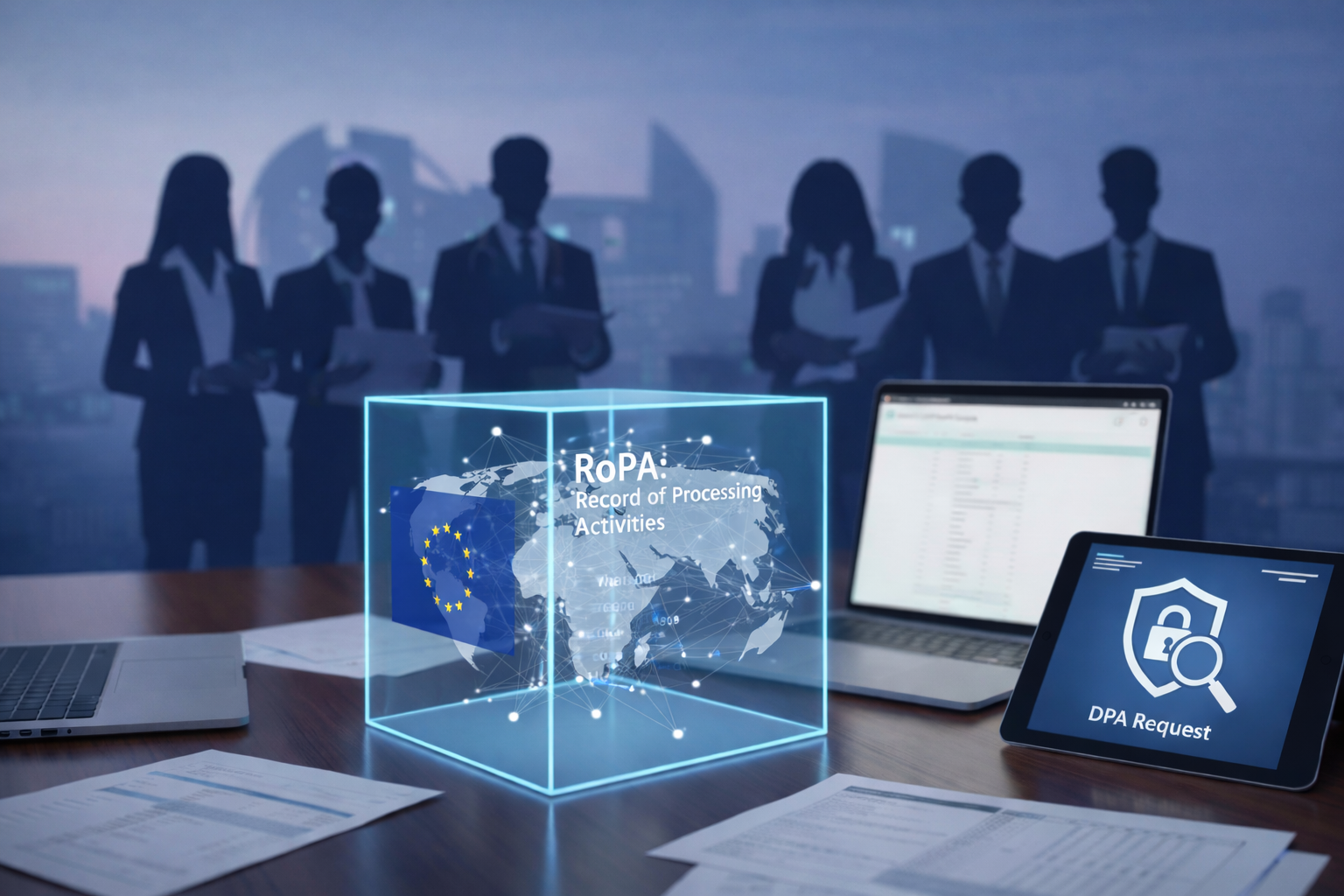
A record of processing activities (often shortened to RoPA) is not a “nice to have”. It is a core GDPR accountability requirement under Article 30 GDPR. In practice, it is also one of the fastest ways to show you understand your own data processing.
A Data Protection Authority can ask to see your record of processing activities, and you should be able to provide it promptly and in a usable format. Moreover, procurement teams, auditors, and investors often treat RoPA as a baseline document in due diligence.
This matters even if you are outside the EU. The GDPR can still apply to you when you offer goods or services to people in the EU, or when you monitor their behaviour. If you fall within scope, you need the same Article 30 discipline as an EU-established company.
Finally, a RoPA is practical, not just legal. It becomes your single source of truth for:
- Rwhat personal data you process,
- Rwhy you process it,
- Rwhere it goes,
- Rhow long you keep it, and
- Rhow you protect it.
Who Is Affected?
It Applies Across Sectors
Because GDPR scope is activity-based, every sector can be affected, including:
- B2B and B2C technology businesses
- Retailers and marketplaces
- Professional services firms
- Manufacturers
- Charities and NGOs
- Education providers
- Healthcare and wellbeing services
- Media and digital platforms
In other words, if you process EU personal data in a structured way, RoPA should be on your list.
Non-EU Companies Are Not “Excluded”
If your organisation has no EU establishment, you may still be caught. This includes many companies in the UK, US, Switzerland, and beyond. You do not need an EU establishment to have GDPR obligations.
You should treat RoPA as evidence that you understand your EU-facing processing. Moreover, it helps you answer the most common question from EU counterparts: “What exactly are you doing with our data?”
Typical Data Flows You Need To Capture
Most organisations have the same recurring streams. A good RoPA covers them end-to-end.
Common examples include:

GDPR + AI Act + DSA: What It Means For Non-EU Companies
With the EU AI Act switching on in phases (and enforcement accelerating), many non-EU teams discover a familiar problem: one product can trigger three EU regulatory frameworks at...

The Data Protection Representative in the EU, UK, and Switzerland: Common Ground and Key Differences
Even when your product, team, and servers sit outside Europe, a data protection representative can be the “forgotten obligation” for companies doing business in the EU, UK, or...

ISO 27001 added value
ISO 27001: Security You Can Rely On At EDPO, we provide representative services under Article 27 of the GDPR and other digital regulations....
Marketing and sales
Website analytics, lead forms, CRM, email campaigns
Customer operations
Account creation, support tickets, call recordings
HR and people ops
Recruitment, payroll, performance management
IT and security
User access logs, device management, incident handling
Finance and compliance
Invoicing, fraud checks, audit trails
Product and service delivery
User behaviour metrics, feature improvement, testing
Even if these feel routine, they still count as “processing activities”.
Employee Tiers And Data Subjects To Think About
RoPA works best when you map processing by “who” as well as “what”. You will usually cover:
- applicants (candidates)
- employees, contractors, and secondees
- customers and end users
- prospects and marketing contacts
- suppliers and business contacts
- visitors (sites, events, reception)
This also helps you spot higher-risk categories quickly, such as children’s data, health data, or sensitive identifiers.
Key Obligations At A Glance
A RoPA is your documented inventory of processing. It should be written and you can keep it electronically. There is no mandated template in the GDPR. You can use Excel, Word, a GRC tool, or a platform export.
That flexibility is helpful, but it also creates confusion. Many teams build a document that looks “official”, yet misses key content.
Below is what you should capture in a practical, audit-friendly way.
1) Know Whether You Are A Controller, A Processor, Or Both
Article 30 has two flavours:
Controller RoPA
records what you decide to do with personal data.
Processor RoPA
records what you do on behalf of clients.
Many organisations are both. For example, you act as controller for HR, but processor for customer-hosted data. Therefore, you may need two views, even if you keep them in one file.
2) Capture The Mandatory Fields For Each Processing Activity
Your RoPA should let you understand your processing without guesswork.
A strong entry usually includes:
- Purpose(s): why you process (e.g., payroll, account management, marketing)
- Categories of data subjects: whose data (e.g., users, employees, prospects)
- Categories of personal data: what data (e.g., contact details, usage logs)
- Recipients: who receives it (vendors, group entities, authorities, partners)
- International transfers: where data goes outside the EEA, and the safeguards used
- Retention: how long you keep it, and the rule that drives it
- Security measures: a high-level note on technical and organisational measures
If you are a processor, you also record:
- categories of processing carried out for each controller client (or client type)
- transfers you make on the controller’s instructions
- security measures you apply
Keep the wording clear and specific. “Business operations” is vague. “Customer onboarding and account administration” is much easier to validate.
3) Keep It Available And Keep It Current
A RoPA is not a one-off spreadsheet you create for a questionnaire. It should be part of your ongoing governance.
In practice, that means:
- you can produce it quickly when asked (including by a Data Protection Authority),
- you review it on a schedule (often quarterly or bi-annually), and
- you update it whenever a team launches a new tool, workflow, or feature.
Moreover, a stale RoPA can be worse than none. It signals that you do not control change.
4) Understand The “Small Company” Exemption Properly
You may have heard that businesses with fewer than 250 employees do not need a RoPA. That idea is commonly misunderstood.
In reality, the exemption is narrow. It does not help if your processing is:
- not occasional, or
- likely to risk people’s rights and freedoms, or
- includes special category data or criminal offence data.
Most modern businesses process personal data continuously. Marketing, HR, and customer support are ongoing. Therefore, most companies should assume they need a RoPA, even if they are small.
5) Use Any Format That Works — But Make It Usable
The GDPR does not force a format. You can use:
- an Excel workbook,
- a Word document, or
- a privacy management platform.
However, your format needs to be searchable, shareable, and maintainable.
In our experience, many teams start with the ICO’s RoPA templates because they are clear and familiar. That is a sensible choice, provided you tailor it to your business.

“Your Representative On The Ground” – EDPO tagline pull-quote
Common Pitfalls
RoPA issues are usually not about effort. They are about structure and ownership. Here are the patterns we see most often.
Pitfall Checklist
 Treating RoPA as a one-time GDPR “tick box”. It then becomes outdated within months.Listing systems instead of processing. “Salesforce” is a tool, not an activity.Using vague purposes. If you cannot explain “why”, you cannot justify the lawful basis later.Ignoring processor responsibilities. Many service providers forget they need a processor RoPA.Missing international transfers. This includes vendor support access, not just hosting location.No retention logic. “We keep it as long as needed” will not satisfy due diligence.Confusing data categories. Teams list “name and email” but forget IDs, logs, and metadata.Forgetting HR and internal IT processing. Those often have the richest data.No owner, no process. Without a defined update workflow, RoPA becomes a museum piece.
A Simple “Good RoPA” Test
Ask yourself three questions:
- Could you explain your processing to a customer using only the RoPA?
- Could you answer “where does the data go?” in under five minutes?
- Could you update it next week if procurement adds a new vendor?
If the answer is “not really”, the document needs a rethink.
How To Build A RoPA That You Can Actually Maintain
RoPA succeeds when it matches how your organisation works. You do not need perfection on day one. You need a clean baseline and a workable update cycle.
Start With Processing Activities, Not Departments
Many teams organise RoPA by department. That can work, but it often creates duplicates and gaps. Instead, consider grouping by lifecycle themes, such as:
- marketing and lead management
- sales and customer onboarding
- service delivery and support
- HR and workplace operations
- IT operations and security
- finance, legal, and compliance
This mirrors how data moves, so it stays readable.
Use A Consistent Level Of Detail
If some rows are one sentence and others are essays, the document becomes hard to scan.
Aim for:
- one activity per row (or per section),
- consistent category lists, and
- short, clear wording.
Moreover, define a glossary once. For example, decide what “customer” means. Is it the contracting entity, or the end user too?
Link RoPA To Your Other GDPR Artefacts
RoPA becomes far more valuable when it connects to:
- your privacy notices (what you tell people),
- your lawful basis assessments (why you can process),
- your DPIAs (where risk is higher),
- your security controls (how you protect), and
- your data retention schedule (how long you keep).
You do not need to build a complex system. Even simple cross-references help.
Set An Update Rhythm That Fits Your Change Cycle
Pick an approach you can stick to:
- Quarterly review with business owners, plus
- change-trigger updates (new tools, new markets, new features, mergers)
Also decide who owns RoPA. Typically, privacy leads the process. However, process owners must supply the facts.
How EDPO Helps
EDPO acts as your EU Representative (and/or UK or Swiss representative, where relevant), providing a reliable point of contact for communications from Data Protection Authorities and data subjects. We support responsiveness and good governance by helping you keep required documentation accessible through the representative relationship.
It is important to be clear about scope. This article is for general information only. EDPO does not provide legal advice through this blog, and we do not provide consultancy services or “run” your compliance programme for you. You remain responsible for determining how the GDPR applies to your processing and for maintaining your RoPA’s accuracy.
Why RoPA Matters Specifically For Representation
Where an EU Representative is required, the representative must be able to cooperate with supervisory authorities. In practice, that means keeping key GDPR documentation available.
As representative, we have an obligation to keep a copy of our client’s RoPA so it can be made available to a Data Protection Authority on request. That is one reason we encourage clients to treat RoPA as a living record, not a one-off file for a questionnaire.
Key Take-Aways
- A record of processing activities is a core accountability requirement under Article 30 GDPR.
- It applies to most organisations in scope, including those with no EU establishment.
- It is important because a Data Protection Authority may ask to see it, and you should be able to produce it promptly.
- There is no mandatory format. Excel, Word, and common templates (like the ICO’s) can work.
- Where you appoint an EU Representative, the representative relationship should include keeping an accessible copy of your RoPA.
NContact us for more information • Need a representative fast? Contact us.
GDPR + AI Act + DSA: What It Means For Non-EU Companies
With the EU AI Act switching on in phases (and enforcement accelerating), many non-EU teams discover a familiar problem: one product can trigger three EU regulatory frameworks at...
The Data Protection Representative in the EU, UK, and Switzerland: Common Ground and Key Differences
Even when your product, team, and servers sit outside Europe, a data protection representative can be the “forgotten obligation” for companies doing business in the EU, UK, or...
ISO 27001 added value
ISO 27001: Security You Can Rely On At EDPO, we provide representative services under Article 27 of the GDPR and other digital regulations....
About the author
Jane Murphy