GDPR and US companies: Up close with a Privacy Shield official

On Tuesday 26 May, EDPO hosted an exclusive webinar on GDPR and US companies with a Privacy Shield official. Rochelle Osei-Tutu shared her insights and answered many questions on this topic.

Is your US company GDPR compliant if it is Privacy Shield certified? What does it really mean to be Privacy Shield certified? How can US companies get a Privacy Shield certification? How will Brexit impact US Privacy Shield certified organizations? Do the EU-U.S. and Swiss-U.S. Privacy Shield programs differ? What kind of oversight and enforcement exist regarding compliance with the Privacy Shield requirements?

Rochelle Osei-Tutu is a Policy Advisor at the U.S. Department of Commerce. Rochelle focuses on the administration of the EU-U.S. and Swiss-U.S. Privacy Shield program and the promotion of cross-border data flows. She provided an overview of the Privacy Shield program and discussed how the Privacy Shield relates to the GDPR.

If you want to watch the recording of our webinar, click on the video below: 

[Soon]


Let us know if you’d like to receive updates about similar webinars or other GDPR-related content by completing the form below:
Brexit and the GDPR

Brexit and the GDPR

Are you in one of these situations? I am a UK Company and I will need an EU Data Protection RepresentativeI am an EU Company and I will need...

About the author

Jane Murphy

Jane Murphy is a Belgian-Canadian lawyer specialising in data protection, corporate law, and EU regulations. She holds law degrees from Canada and Belgium, an LL.M. in EU and International Law, a Data Protection Certificate, and completed an International Business summer programme at Harvard, and an “AI:Implications for Business Strategy » executive program at MIT. Jane also has 15+ years of board experience across Europe and Asia and currently chairs Oracle Financial Services Software (OFSS) in Mumbai.

Jane Murphy

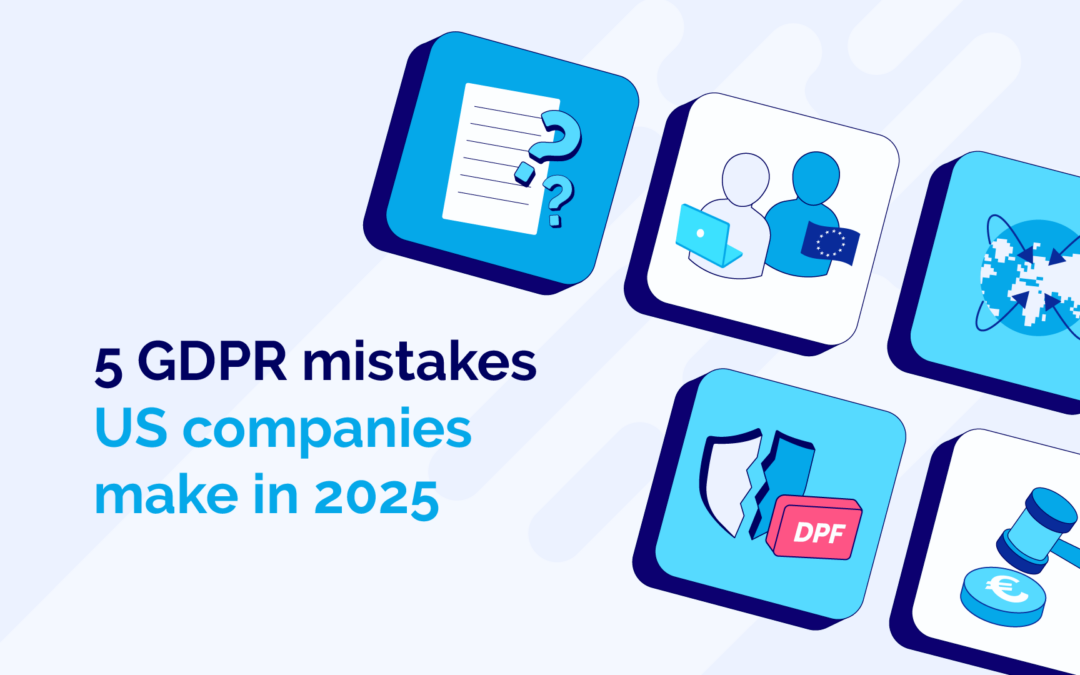
The General Data Protection Regulation (GDPR) continues to apply to many US companies in 2025, even if they do not have a physical presence in the European Union. Despite years of guidance and enforcement, the same misunderstandings keep reappearing. Here are five of the most common GDPR mistakes US companies make — and how to avoid them.

Mistake 1 – Confusing the Data Protection Officer (DPO) with the EU GDPR Representative

An EU GDPR Representative is a local contact point for data protection authorities and individuals in the EU. Non-EU companies that are subject to the GDPR must appoint a representative to ensure smooth communication and compliance.

A Data Protection Officer (DPO) is responsible for overseeing a company’s internal data protection strategy and ensuring compliance with the GDPR. The DPO monitors data processing, conducts audits, and trains staff.

The DPO works inside the organisation, while the GDPR Representative is based in the EU and acts as an external contact point. Many US companies confuse the two roles, but under the GDPR, they are separate obligations and sometimes both are required.

Mistake 2 – Misunderstanding the extraterritorial scope of the GDPR

The GDPR applies to non-EU companies if they offer goods or services to individuals in the EU or monitor their behaviour online. This applies regardless of where the company is located.

Selling products to EU customers, operating an EU-facing website in EU languages, accepting payments in euros, or tracking EU visitors with cookies or analytics tools can all trigger GDPR obligations.

Mistake 3 – Incorrectly relying on the Privacy Shield (now EU-US Data Privacy Framework)

The Privacy Shield was an agreement that allowed certified US companies to transfer personal data from the EU to the US. In 2020, it was invalidated by the Court of Justice of the European Union in the Schrems II decision.

In 2023, the EU-US Data Privacy Framework (DPF) replaced the Privacy Shield. While participation in the DPF can help facilitate transatlantic data transfers, it does not exempt companies from GDPR compliance.

US companies must ensure that data transfers are lawful under the GDPR. This may involve joining the DPF, using Standard Contractual Clauses (SCCs), or implementing other approved safeguards.

Mistake 4 – Incomplete or unclear privacy policies

The GDPR requires privacy policies to be clear, accessible and transparent. They must explain what personal data is collected, how it is used, the legal basis for processing, and the rights of data subjects.

Many US companies omit details such as data retention periods, contact information for the EU Representative, or instructions on how to exercise data subject rights. 

Mistake 5 – Underestimating GDPR fines and enforcement

Data protection authorities have issued fines to companies of all sizes, including non-EU businesses. In 2025, penalties for non-compliance remain high — up to €20 million or 4% of annual global turnover, whichever is higher.

Regular compliance reviews Data Protection Impact Assessments (DPIAs), staff training, and appointing an EU GDPR Representative can help mitigate risks.

How EDPO can help your business stay GDPR compliant

EDPO acts as your official EU GDPR Representative, ensuring compliance with Article 27 of the GDPR and facilitating communication with EU authorities.

For companies targeting the UK market, EDPO also offers UK GDPR Representative services to ensure compliance with the UK’s data protection regime.

Follow us on Linkedin for daily breaking GDPR news!

The General Data Protection Regulation (GDPR) continues to apply to many US companies in 2025, even if they do not have a physical presence in the European Union. Despite years of guidance and enforcement, the same misunderstandings keep reappearing. Here are five of the most common GDPR mistakes US companies make — and how to avoid them.

Mistake 1 – Confusing the Data Protection Officer (DPO) with the EU GDPR Representative

An EU GDPR Representative is a local contact point for data protection authorities and individuals in the EU. Non-EU companies that are subject to the GDPR must appoint a representative to ensure smooth communication and compliance.

A Data Protection Officer (DPO) is responsible for overseeing a company’s internal data protection strategy and ensuring compliance with the GDPR. The DPO monitors data processing, conducts audits, and trains staff.

The DPO works inside the organisation, while the GDPR Representative is based in the EU and acts as an external contact point. Many US companies confuse the two roles, but under the GDPR, they are separate obligations and sometimes both are required.

Mistake 2 – Misunderstanding the extraterritorial scope of the GDPR

The GDPR applies to non-EU companies if they offer goods or services to individuals in the EU or monitor their behaviour online. This applies regardless of where the company is located.

Selling products to EU customers, operating an EU-facing website in EU languages, accepting payments in euros, or tracking EU visitors with cookies or analytics tools can all trigger GDPR obligations.

Mistake 3 – Incorrectly relying on the Privacy Shield (now EU-US Data Privacy Framework)

The Privacy Shield was an agreement that allowed certified US companies to transfer personal data from the EU to the US. In 2020, it was invalidated by the Court of Justice of the European Union in the Schrems II decision.

In 2023, the EU-US Data Privacy Framework (DPF) replaced the Privacy Shield. While participation in the DPF can help facilitate transatlantic data transfers, it does not exempt companies from GDPR compliance.

US companies must ensure that data transfers are lawful under the GDPR. This may involve joining the DPF, using Standard Contractual Clauses (SCCs), or implementing other approved safeguards.

Mistake 4 – Incomplete or unclear privacy policies

The GDPR requires privacy policies to be clear, accessible and transparent. They must explain what personal data is collected, how it is used, the legal basis for processing, and the rights of data subjects.

Many US companies omit details such as data retention periods, contact information for the EU Representative, or instructions on how to exercise data subject rights. 

Mistake 5 – Underestimating GDPR fines and enforcement

Data protection authorities have issued fines to companies of all sizes, including non-EU businesses. In 2025, penalties for non-compliance remain high — up to €20 million or 4% of annual global turnover, whichever is higher.

Regular compliance reviews Data Protection Impact Assessments (DPIAs), staff training, and appointing an EU GDPR Representative can help mitigate risks.

How EDPO can help your business stay GDPR compliant

EDPO acts as your official EU GDPR Representative, ensuring compliance with Article 27 of the GDPR and facilitating communication with EU authorities.

For companies targeting the UK market, EDPO also offers UK GDPR Representative services to ensure compliance with the UK’s data protection regime.

Get our weekly newsletter in your inbox every Monday with fresh GDPR and Data Protection news!